

Better sound starts with placement: where you sit, where the speakers face, and how sound moves through the space.

The Room Comes Before the Speakers
A good music setup does not start with the product. It starts with the room.
Before placing a pair of Bookshelf Speakers, look at how the space is used. Where do you usually sit? Is the room narrow or wide? Are the speakers going on a desk, shelf, sideboard, or media console? These details decide how sound reaches you.
The product manual shows several speaker placement methods, including the equilateral triangle method, three-three-one ratio method, three-seven ratio method, and inward axis method. These methods all focus on one thing: the relationship between the two speakers and the listener.
That is why speaker placement should not be treated as decoration. A speaker is not only placed in a room. It is aimed into the room.

Start With the Equilateral Triangle
The easiest starting point is the equilateral triangle method.
Place the two speakers apart, then sit at a similar distance from both. In simple terms, the two speakers and your listening position form a triangle.
This method works well for desks, reading corners, and small living rooms. It helps create a more stable center image, so vocals and instruments feel less scattered.
The goal is not to turn the room into a studio. It is to avoid random placement. Once you know where you sit, the speakers become easier to position.

Use the Three-Three-One Ratio for Close Listening
For closer listening, such as a desk or compact room, the three-three-one ratio method is useful.
The idea is simple: do not push the speakers too deep into the shelf or directly against the wall. Leave some space around them, and keep the listening position close enough for a clear sound image.
This matters in real homes because speakers are often placed on furniture that already holds books, screens, lamps, or daily objects. If the front drivers are blocked, the sound will lose clarity.
The COOLGEEK Bookshelf Speakers measure about 19.2 × 12.3 × 18 cm, which makes them easy to place on common home surfaces. The main speaker weighs about 1.9 kg, and the secondary speaker weighs about 1.7 kg, giving the pair a stable feel for desk, shelf, or sideboard placement.
Compact size makes placement easier, but the speakers still need room to breathe.

Use the Inward Axis Method for Better Focus
Speaker angle changes what you hear.
The inward axis method means turning the speakers slightly toward the listening position. This can make vocals feel more centered and improve the focus of instruments.
This method is useful when the room is not perfectly symmetrical. For example, one side may have a wall, while the other side opens into a larger area. A slight inward angle helps the speakers aim more directly at the listener.
For daily use, the rule is simple: let the speakers face where you actually listen.
Not the wall.
Not the center of an empty room.
The listener should be the target.

Try the Three-Seven Ratio in Larger Rooms
If the room is larger or more balanced, the three-seven ratio method can help create a wider soundstage.
This method pays attention to the distance between the two speakers and the distance from the speakers to the listener. If the speakers are too close together, the sound can feel narrow. If they are too far apart, the center can become weak.
A good ratio helps the sound feel more even across the room.
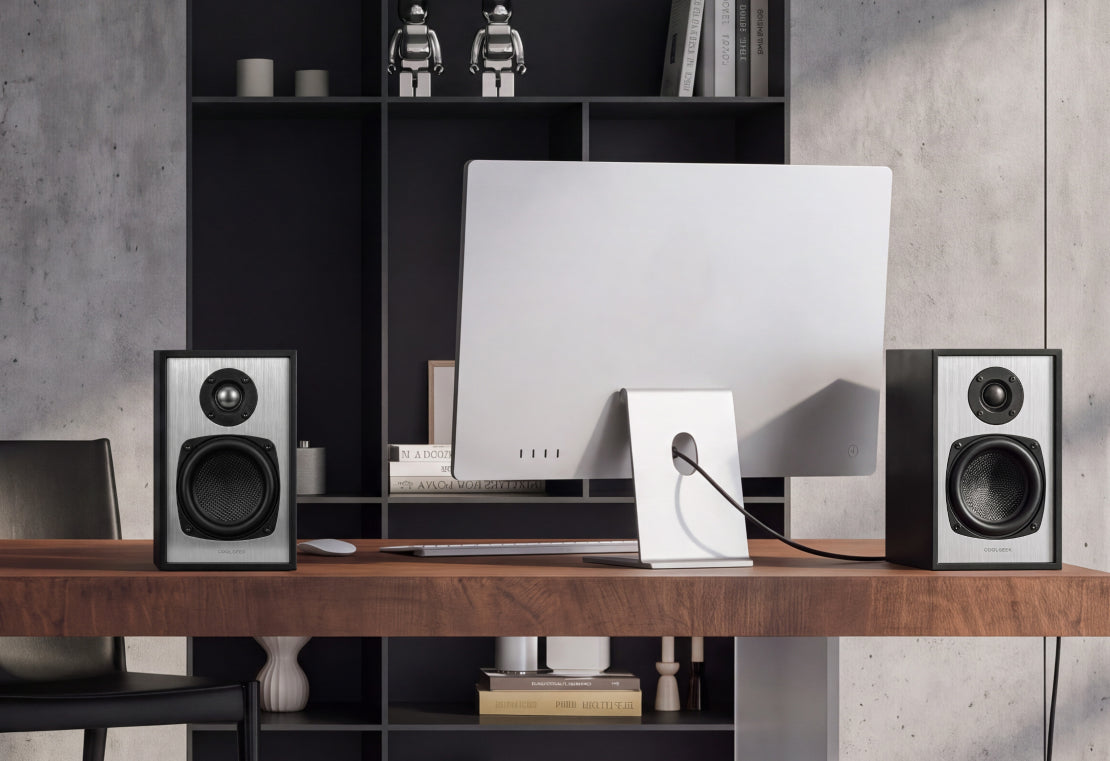
This is where a compact speaker pair can be practical. The Bookshelf Speakers can sit on a shelf, sideboard, or desk without taking over the room, while still giving enough separation for a proper stereo setup.
The product uses a 10W 1-inch silk dome tweeter and a 30W 3.5-inch composite mid-bass driver, supporting both high-frequency detail and body for everyday listening.
Good placement allows those drivers to work more naturally.

Let Sound Travel Clearly
No placement method works well if the sound path is blocked.
Avoid placing books, plants, screens, or decorative objects directly in front of the speaker drivers. The front of the speakers should face the listening area as clearly as possible.
This does not mean the room has to be empty. It simply means the speakers need a clean path toward the listener.
The COOLGEEK Bookshelf Speakers are built for real home placement. They can work on a desk, shelf, or sideboard, and they can support different listening sources through home-friendly connections such as Bluetooth, AUX, and USB Audio.
But connection comes after placement.
First decide where the sound should go. Then decide how the music enters.
A Good Setup Is Planned, Not Complicated
A better music setup does not need to be difficult.
Start with the room. Find your listening position. Give the speakers space. Adjust their angle. Keep the sound path clear.
Then choose the placement method that fits your home:
Use the equilateral triangle method as a balanced starting point. Use the three-three-one ratio for close listening. Use the three-seven ratio for larger rooms. Use the inward axis method when the room needs more focus.
The COOLGEEK Bookshelf Speakers are compact enough for real homes, but placement still matters. When positioned well, they can make music feel clearer, more balanced, and more natural.
Good sound does not only come from the speakers.
It also comes from where the speakers live.
Share:
COOLGEEK P1 on GizmoCrowd: A Clearer Way to Connect
How to Choose a Music Gift That Feels Personal